Hostinger is a popular starting point for many websites, but a low entry price does not always remain the best fit as your website grows.
Traffic, storage needs, performance, security, support, and server control can all change what you actually need from a hosting plan.
This guide compares the factors that matter beyond the advertised price, helping you understand which type of hosting can better match your website today and as it grows.
Why Look Beyond Hostinger?
Hostinger covers many common hosting needs, but websites can have very different requirements. Renewal pricing, available resources, performance technology, support, and upgrade options can all affect the overall value.
| What Matters | What to Check | Why It Matters |
| Long Term Cost | Promotional and renewal pricing | Shows what hosting may cost over time |
| Performance | NVMe/SSD, CPU, RAM, caching | Helps websites handle everyday workloads |
| Security | SSL, backups, malware, DDoS | Adds protection and recovery options |
| Support | Migration and technical assistance | Makes hosting easier to manage |
| Scalability | VPS, VDS, dedicated options | Provides room for future growth |
Looking at these areas before switching can help you choose hosting based on your website’s actual requirements rather than simply selecting the lowest advertised price.
How We Compared the Hosting Options
We focused on the features that remain important after a website goes live, including server resources, performance tools, security, pricing, support, and available upgrade paths.
| Area | What We Reviewed | Why We Checked It |
| Infrastructure | NVMe/SSD, CPU, RAM, bandwidth | Shows the resources available to websites |
| Performance | LiteSpeed, caching, CDN | Helps assess content delivery and processing |
| Security | SSL, backups, malware, DDoS | Shows the protection offered with relevant plans |
| Pricing | Starting price, renewal, billing period | Helps judge the actual cost |
| Scalability | Higher plans, VPS, VDS, dedicated | Shows how easily a website can grow |
Top 5 Best Hostinger Alternatives in 2026
A low hosting price is only part of the decision. We looked at five Hostinger alternatives to compare what you actually get in terms of resources, performance, security, support, and scalability.
1. YouStable – NVMe Hosting with LiteSpeed
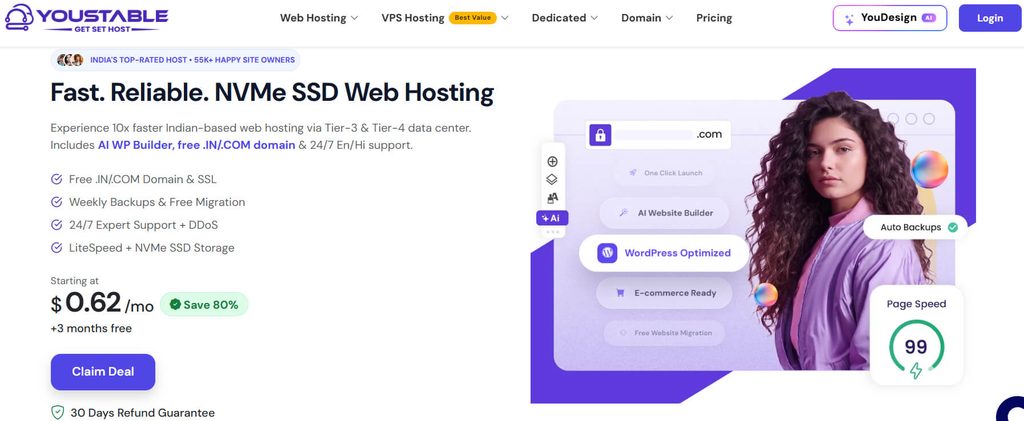
YouStable offers shared hosting, WordPress hosting, VPS, Windows VPS, dedicated servers, and domain services, giving users options for both small websites and growing workloads.
Shared hosting starts at $0.62/month, while VPS starts at $3.67/month. The current offer shows up to 80% savings, with extra free months on qualifying plans.
Overall, YouStable fits bloggers, WordPress users, businesses, developers, and India-focused websites looking for NVMe storage, LiteSpeed, migration support, and a path toward VPS or dedicated hosting.
Key Features
YouStable brings storage, caching, security, backups, and website management features together across its applicable hosting plans.
- NVMe SSD Storage: Faster storage access for website files, databases, applications, and content.
- LiteSpeed & LSCache: Caching helps serve frequently requested content with less repeated processing.
- Free SSL: Encrypts connections between visitors and hosted websites.
- Website Migration: Helps eligible customers move an existing website to YouStable.
- Backup Options: Provides recovery points for website data.
- DDoS Protection: Helps reduce the effect of malicious traffic floods.
Performance & Security
YouStable combines NVMe storage, LiteSpeed, caching, SSL, backups, and security tools to support website performance and everyday protection.
- NVMe & LiteSpeed: Provides performance-focused infrastructure for regular website workloads.
- LSCache: Caches frequently requested content to reduce repeated processing.
- SSL Protection: Encrypts information transferred between visitors and websites.
- DDoS Protection: Helps mitigate malicious traffic targeting server resources.
- Malware Protection: Imunify360 is available on applicable hosting plans.
- Backup Protection: Provides recovery points for restoring earlier website data.
Plans & Pricing
| Plan | Starting Price | Key Resources | Suitable For |
| Shared Hosting | $0.62/mo | 50 GB NVMe, 1 website, unmetered bandwidth | Blogs and small websites |
| VPS Hosting | $3.67/mo | 1 CPU, 4 GB RAM, 50 GB NVMe, 4 TB bandwidth | Developers and growing projects |
| Windows VPS | $19.99/mo | 2 cores, 4 GB RAM, 60 GB NVMe, 1 TB bandwidth | Windows applications |
| Dedicated Server | $77.99/mo | 4 CPU, 32 GB RAM, 480 GB SSD, 10 TB bandwidth | High-resource workloads |
The supplied pricing information shows up to 80% savings, with 3 extra months free on Shared Hosting and 2 extra months free on VPS, Windows VPS, and Dedicated Server. The offer also states renewal at the same price.
Who Should Choose YouStable?
YouStable is a practical fit for bloggers, WordPress users, Indian businesses, developers, and growing websites that want affordable hosting today with access to higher-resource infrastructure later.
2. HostPapa – Business Hosting Made Simple
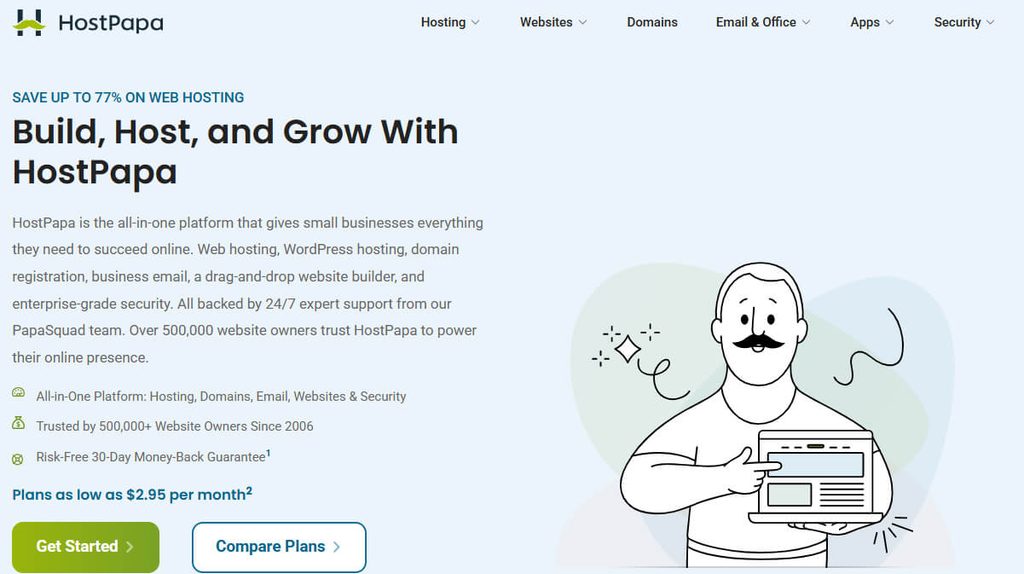
HostPapa offers shared hosting, WordPress hosting, VPS, and dedicated servers, giving beginners and small businesses several options as their website requirements change.
The supplied pricing shows Web Hosting and WordPress Hosting from $2.95/month, with VPS and dedicated hosting available for websites needing additional resources and control.
Overall, HostPapa suits users who value simple website management, business email, migration assistance, security features, and an upgrade path beyond basic shared hosting.
Key Features
HostPapa combines website management, security, performance tools, email, and migration features across its applicable hosting services.
- Free SSL: Encrypts connections between visitors and hosted websites.
- Website Migration: Helps eligible customers transfer existing websites.
- CDN Support: Helps deliver cached content from locations closer to visitors.
- Security Tools: Includes malware scanning and firewall protection on applicable plans.
- Business Email: Supports professional email addresses using your domain.
- Multiple Hosting Types: Shared, WordPress, VPS, and dedicated hosting cover different requirements.
Performance & Security
HostPapa uses SSD based hosting with caching and CDN support, while security features help protect websites against common online threats.
- SSD Storage: Provides responsive storage access for website files and databases.
- CDN Support: Helps deliver cached content closer to website visitors.
- Caching: Reduces repeated processing for frequently requested content.
- SSL Protection: Encrypts connections between visitors and websites.
- Malware Scanning: Helps identify potentially harmful website files.
- Brute-Force Protection: Helps protect hosting accounts against repeated unauthorized login attempts.
Plans & Pricing
| Plan | Starting Price | Hosting Type | Suitable For |
| Web Hosting | $2.95/mo | Shared Hosting | Small websites |
| WordPress Hosting | $2.95/mo | WordPress Hosting | WordPress websites |
| VPS Hosting | $2.95 | VPS | Growing businesses |
| Dedicated Hosting | $59.95/mo | Dedicated Server | High-resource websites |
The prices above are based on the supplied pricing information. Promotional rates can depend on the billing period, while renewal pricing and included resources may differ, so the current plan should be checked before purchase.
Who Should Consider HostPapa?
HostPapa is a suitable choice for small businesses, beginners, WordPress users, and service-based websites that want hosting, email, security, migration, and higher-resource options from one provider.
3. UltaHost – Flexible Hosting for Growing Websites

UltaHost offers shared hosting, WordPress hosting, VPS, VDS, and dedicated servers, giving website owners several infrastructure choices as their requirements increase.
The supplied pricing shows Shared Starter at $4.39/month, with VPS, VDS, and dedicated options available for websites that need additional resources and control.
Overall, UltaHost is a practical option for users who want to start with simpler hosting and move toward higher-resource infrastructure without changing providers.
What You Get
UltaHost provides a broad range of hosting services, making it possible to choose an environment according to your website’s workload.
- Shared Hosting: A simpler starting point for new and smaller websites.
- WordPress Hosting: Hosting designed around WordPress websites.
- VPS Hosting: Provides greater resource control than shared hosting.
- VDS Hosting: Offers a higher-resource environment for demanding workloads.
- Dedicated Servers: Provides dedicated infrastructure for resource-heavy projects.
- Website Migration: Helps users move existing websites to the platform.
Performance & Security
UltaHost’s range of hosting environments gives users flexibility to move toward higher resources when shared hosting is no longer sufficient.
- Resource Scaling: Higher hosting levels provide additional resources as requirements increase.
- VPS Resources: Provides a more controlled environment than shared hosting.
- WordPress Optimization: Offers hosting designed around WordPress performance requirements.
- SSL Protection: Helps encrypt connections between websites and visitors.
- Account Security: Includes security controls such as two-factor authentication.
- Higher-Resource Infrastructure: VDS and dedicated options provide more resources for demanding workloads.
Plans & Pricing
| Plan | Price | Hosting Type | Suitable For |
| Shared Starter | $4.39/mo | Shared Hosting | New websites |
| VPS Basic | $6.89/mo | VPS | Growing websites |
| Power Plus | $47.29/mo | VDS | Higher-resource projects |
| Ultra-X | $104.99/mo | Dedicated Hosting | High-resource websites |
These prices are based on the supplied pricing information. Promotional rates, billing periods, renewal pricing, and included resources can change, so the current checkout details should be verified before purchase.
Who Should Consider UltaHost?
UltaHost fits new websites, WordPress users, developers, growing businesses, and higher-resource projects that want several hosting levels available under one provider.
It is particularly useful when you expect your hosting requirements to increase and want options beyond shared hosting without immediately moving to another host.
4. BigRock – cPanel Hosting for Easy Management

BigRock combines domain registration with Linux and Windows hosting, WordPress hosting, VPS, dedicated servers, and other website services for different requirements.
Its Linux hosting plans use NVMe SSD storage and cPanel, with applicable packages offering SSL, daily backups, email accounts, and malware scanning.
Overall, BigRock is a practical option for users who prefer familiar cPanel management and want domains, hosting, email, and website services under one platform.
Features Worth Checking
BigRock brings several everyday hosting features together, particularly for users managing websites through cPanel.
- NVMe SSD Storage: Provides fast access to website files and databases.
- cPanel: Gives users a familiar interface for managing hosting services.
- Free SSL: Encrypts connections between visitors and websites.
- Daily Backups: Provides recent recovery points for website data.
- Email Accounts: Supports professional email addresses using your domain.
- Malware Scanning: Helps identify potentially harmful files on applicable plans.
Performance & Security
BigRock combines NVMe storage, Varnish caching, SSL, backups, and malware scanning to support website performance and everyday security.
Its current hosting offering also advertises a 99.99% uptime guarantee, which is a provider-stated service commitment and should not be interpreted as uninterrupted performance under every circumstance.
Plans & Pricing
| Plan | Price | Resources | Suitable For |
| Standard | ₹69/mo | 20 GB NVMe, 1 website, 10 email accounts | Small websites |
| Business | ₹99/mo | 50 GB NVMe, 3 websites, 50 email accounts | Growing websites |
| Pro | ₹129/mo | 100 GB NVMe, 5 websites, 100 email accounts | Established websites |
| Ultimate | ₹149/mo | 200 GB NVMe, 10 websites, 200 email accounts | Larger websites |
The supplied pricing also lists separate renewal rates. Standard renews at ₹409/month, while Business, Pro, and Ultimate renew at ₹649, ₹759, and ₹989/month respectively. The applicable billing term and current promotion should be checked before purchase.
Who Should Consider BigRock?
BigRock suits small websites, businesses, cPanel users, domain buyers, and growing projects that prefer keeping hosting and domain services together.
Its combination of cPanel, NVMe storage, email, backups, and multiple shared hosting levels makes it a straightforward option for users who want familiar hosting management.
5. HostyCare – Resource-Focused Shared Hosting

HostyCare offers shared hosting, WordPress, WooCommerce, VPS, cloud, and dedicated server solutions for websites with different resource requirements.
Its shared hosting plans use NVMe storage and include features such as LiteSpeed with CDN, free SSL, migration, backups, malware scanning, cPanel, and developer tools on applicable plans.
Overall, HostyCare is a useful option for developers, WordPress users, and growing websites that want clearly defined CPU, RAM, PHP worker, and I/O resources before moving to VPS hosting.
Features That Stand Out
HostyCare focuses on giving shared hosting users a broad set of performance, security, and development features.
- NVMe SSD Storage: Provides fast storage access for website files and databases.
- LiteSpeed & CDN: Helps cache and deliver website content efficiently.
- Free Site Migration: Assists eligible users with transferring existing websites.
- Daily Malware Scanning: Checks websites for potentially harmful files.
- Developer Tools: Includes SSH, Git, terminal access, Node.js, Python, and PHP support.
- Managed WordPress: Provides tools designed around WordPress website management.
Performance & Security
HostyCare combines NVMe storage with defined CPU and RAM resources, LiteSpeed, CDN support, backups, malware scanning, and attack prevention.
Its higher shared hosting plans provide substantially more CPU, RAM, PHP workers, storage, and I/O capacity, giving growing websites more room before a move to VPS becomes necessary.
Shared Hosting Pricing
| Plan | Price | Resources | Suitable For |
| Basic | ₹59/mo | 25 GB NVMe, 1 CPU, 1 GB RAM | Personal websites |
| Starter | ₹129/mo | 50 GB NVMe, 2 CPU, 2 GB RAM | Small businesses |
| Business | ₹239/mo | 120 GB NVMe, 3 CPU, 3 GB RAM | Growing websites |
| Enterprise | ₹599/mo | 200 GB NVMe, 4 CPU, 8 GB RAM | Resource-heavy websites |
The supplied pricing is shown for 36-month terms, with the plans stating “Buy & Renew at the Same.” PHP worker and I/O limits also increase across the plans, giving higher tiers more processing capacity.
Who Should Consider HostyCare?
HostyCare is a good fit for developers, WordPress users, growing businesses, and resource-heavy websites that want more defined shared hosting resources and development tools.
Its higher shared plans can be particularly useful when a website needs more CPU, RAM, storage, PHP workers, or I/O capacity without immediately moving to a VPS.
Hostinger Alternatives Compared
The five options differ in pricing, resources, management tools, and upgrade paths. This quick comparison makes the main differences easier to see before choosing a plan.
| Provider | Starting Price | Main Strength | Suitable For |
| YouStable | $0.62/mo | NVMe, LiteSpeed, flexible infrastructure | Indian websites and growing projects |
| HostPapa | $2.95/mo | Business-focused hosting and management | Small businesses and beginners |
| UltaHost | $4.39/mo | Wide range of hosting environments | Growing websites and developers |
| BigRock | ₹69/mo | cPanel, domains, and email | Small websites and businesses |
| HostyCare | ₹59/mo | Defined CPU, RAM, and NVMe resources | Developers and resource-heavy sites |
These are the starting prices available in the supplied comparison material. Promotional rates, billing terms, renewal pricing, and included features can vary between plans, so check the provider’s current pricing before purchasing.
YouStable vs HostPapa
YouStable puts more emphasis on NVMe storage, LiteSpeed, India-focused hosting, and multiple server options. HostPapa is more oriented toward small businesses, beginners, email, and managed website services.
YouStable vs UltaHost
Both offer several hosting levels for growing websites. UltaHost has a broad progression from shared hosting to VPS, VDS, and dedicated servers, while YouStable combines similar upgrade options with India-focused hosting and support.
YouStable vs BigRock
BigRock is particularly convenient for users who want domains, hosting, email, and cPanel together. YouStable offers a stronger performance-focused setup with NVMe and LiteSpeed across applicable hosting plans.
YouStable vs HostyCare
Both providers offer NVMe-based hosting and performance features. HostyCare stands out for clearly defined CPU, RAM, PHP worker, and I/O resources, while YouStable offers a broader range of hosting products.
Which Alternative Makes the Most Sense?
There is no universal replacement for Hostinger. The right option depends on your website size, budget, technical requirements, location, and expected growth.
YouStable for a Balanced Hosting Setup
YouStable is the strongest overall choice in this comparison for users looking for NVMe storage, LiteSpeed, migration assistance, India-focused support, and an upgrade path from shared hosting to VPS or dedicated servers.
HostPapa for Small Businesses
HostPapa makes more sense for small businesses and beginners who want hosting, WordPress options, email, security, migration assistance, and simple website management.
UltaHost for More Infrastructure Choices
UltaHost suits users who want several hosting environments available as their requirements change, including shared hosting, VPS, VDS, and dedicated servers.
BigRock for cPanel and Domains
BigRock is a practical choice when cPanel management, domain registration, business email, and multiple shared hosting levels are important.
HostyCare for More Shared Resources
HostyCare is worth considering when CPU, RAM, NVMe storage, PHP workers, and I/O limits are important factors in your hosting decision.
Quick Recommendation
- YouStable: India-focused hosting and balanced performance
- HostPapa: Small businesses and beginners
- UltaHost: Multiple hosting and upgrade options
- BigRock: cPanel and domain services
- HostyCare: Resource-focused shared hosting
How to Pick the Right Hostinger Alternative
The right hosting choice depends on your website’s current workload, budget, technical needs, and how much room you expect to need later. These steps can help narrow down the options.
Step 1: Start With Your Website Type
A personal blog does not need the same resources as an online store or a business website. First, identify what you are actually hosting.
| Website Type | Typical Requirement | Features to Prioritize |
| Personal Blog | Basic resources | Shared hosting, SSL, backups |
| WordPress Site | Moderate resources | Caching, PHP support, SSD/NVMe |
| Business Website | Reliable resources | Security, email, support |
| Online Store | Higher resources | CPU, RAM, caching, backups |
Step 2: Check the Resources
Look beyond storage capacity. CPU, RAM, website limits, bandwidth, and storage technology can all affect how your hosting performs.
Pay particular attention to:
- CPU: Processing capacity for website tasks
- RAM: Helps handle applications, databases, and concurrent requests
- Storage: Check capacity and whether it uses SSD or NVMe
- Websites: Confirm the number of sites allowed
- Bandwidth: Check the provider’s stated allocation or limits
Step 3: Compare Speed Features
Look at the technology behind the hosting plan instead of relying only on general speed claims.
Check for NVMe or SSD storage, LiteSpeed, server-side caching, LSCache, and CDN support where relevant. These features can help websites deliver content more efficiently, although actual speed also depends on the website itself.
Step 4: Review the Security Setup
Security features vary between providers and plans, so check the exact package you intend to buy.
| Feature | What to Check |
| SSL | Whether a free certificate is included |
| Backups | Backup frequency and restoration options |
| Malware Protection | Whether scanning is included |
| DDoS Protection | Whether traffic mitigation is provided |
| Firewall | Whether an additional security layer is available |
Step 5: Calculate the Actual Cost
A low promotional price does not always represent the amount you will pay over several years. Compare the initial rate with renewal pricing, billing terms, and included features.
Check the:
- Starting price
- Renewal price
- Billing period
- Domain charges
- Storage allowance
- Website limits
- Email accounts
- Backup and migration features
Step 6: Look at Support
Good support becomes especially useful during migration, setup, or unexpected hosting problems.
Check whether the provider offers website migration, responsive support, a suitable control panel, technical documentation, and developer tools if your project requires them.
Step 7: Leave Room for Growth
A website can outgrow shared hosting as traffic, content, databases, or applications become more demanding.
A useful upgrade path can look like:
Shared Hosting → Higher Shared Plan → VPS/VDS → Dedicated Server
Choosing a provider with these options can save you from moving everything to another host when your resource requirements increase.
Step 8: Match the Host to Your Priority
Once you know what your website needs, the choice becomes much simpler.
| Your Priority | Option to Consider | Main Reason |
| India-focused hosting | YouStable | India-based options and broader infrastructure |
| Small business hosting | HostPapa | Business-focused services and simple management |
| Hosting variety | UltaHost | Shared, VPS, VDS, and dedicated options |
| cPanel and domains | BigRock | cPanel hosting with domain services |
| Shared resources | HostyCare | Clearly defined CPU, RAM, PHP worker, and I/O resources |
The goal is not to find the cheapest alternative to Hostinger. It is to find a plan that gives your website the right resources and features today without creating unnecessary limits tomorrow.
FAQs
What is the best Hostinger alternative in 2026?
YouStable is our top overall choice for its NVMe storage, LiteSpeed technology, India focused hosting, migration assistance, and range of hosting options.
Which Hostinger alternative is good for beginners?
HostPapa is a practical choice for beginners who want simple website management, WordPress hosting, business email, security features, and migration assistance.
Is switching from Hostinger worth it?
It can be worthwhile when another provider offers resources, pricing, support, or features that better match your website. Compare the complete plan before making the move.
What should I check before choosing an alternative?
Focus on the areas that can affect your website’s cost, performance, security, and future requirements:
• Performance: NVMe/SSD, CPU, RAM, caching, and CDN
• Security: SSL, backups, malware and DDoS protection
• Pricing: Starting price, renewal cost, and billing period
• Growth: Higher plans, VPS, VDS, or dedicated servers
Conclusion
Hostinger remains a solid option for many websites, but it is not the only choice when your requirements change. Pricing, server resources, performance features, security, support, and upgrade options can all affect the better fit.
YouStable stands out in this comparison for its NVMe storage, LiteSpeed technology, India focused hosting, migration assistance, and range of hosting options. HostPapa suits small businesses, while UltaHost offers several paths for websites that expect to grow.
BigRock is worth considering for cPanel and domain services, while HostyCare offers clearly defined resources for users who need more from shared hosting. The final decision should come down to your website’s actual requirements, budget, and expected growth.